Initiatives in bioeconomy, socio-bioeconomy and biodiversity;
Brazil Solutions
Check out the case studies from CEBDS Associates.
Brazil is a country of continental dimensions and unique riches. It is home to some of the most important biomes on the planet, one of the cleanest energy matrices in the world, and a society marked by creativity and adaptability. This combination shows the world that it is possible to align economic development, social inclusion, and environmental preservation. And the private sector has much to contribute to this sustainable development.
It is in this spirit that the Brazil Solutions, an initiative of CEBDS – Brazilian Business Council for Sustainable Development, with support from Accenture. The goal is to give visibility to concrete projects that are shaping a sustainable future, connecting companies, communities, and investors around a common purpose: accelerating the climate transition to a low-carbon, inclusive, and resilient economy.
The results of this mobilization are impressive. They were mapped 135 initiatives, conducted by companies associated with CEBDS, which represent 18 strategic sectors of the Brazilian economy. Of these, 74 were selected for this publication., as examples of solutions already underway and with great potential for expansion.
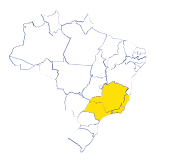
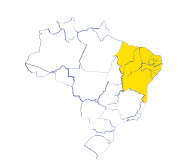
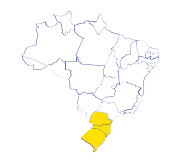
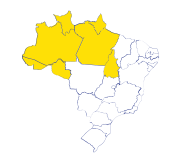
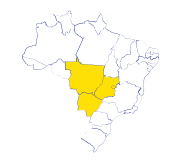
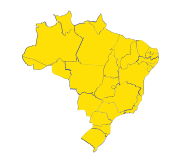
These initiatives are present in all regions and biomes of the country:
From an ecological point of view, the representation is broad:
The solutions are distributed across six major themes that reflect the main drivers of transformation in Brazil:
Initiatives in renewables and energy efficiency;
Initiatives in circular economy, waste and mining;
Initiatives in conservation, productive inclusion, and monitoring;
Initiatives in water, mobility and sustainable cities;
Initiatives in regenerative pastures, manure, and traceability.
More than just numbers, what we see is a consistent movement:
Initiatives are already in the expansion phase., revealing maturity and the possibility of replication;
The projects include technical documentation. which attests to its social and environmental impact;
They focus on climate mitigation and adaptation., including emissions reductions and carbon credits;
They monitor their results using internationally recognized methodologies., like the GHG Protocol;
They are directly linked to the reduction of emissions., whether in Scope 1 (21%), Scope 2 (15%) or Scope 3 (42%);
These case studies contribute to Brazil's NDC, highlighting the ambition to reduce GHG emissions.85% connect to the Sustainable Development Goals (SDGs)., with particular emphasis on SDG 13 – Climate Action (66%), SDG 12 – Responsible Consumption and Production (41%) and SDG 9 – Industry, Innovation and Infrastructure (38%).
The social dimension is also central:
The projects involve local communities, increasing income and inclusion;
They partner with educational institutions., Strengthening research and innovation;
They involve collaborations with other organizations., reinforcing the idea that sustainability is built through networks.
However, the numbers also reveal challenges. Half of the projects analyzed need to raise additional funds. to be implemented or expanded. Although 70% already reports investment figures, Most do not have payback calculations or financial self-sustainability plans. Only 7.4% accessed climate or impact funds, 6 projects obtained green credit, and only 8 utilize Payment for Environmental Services (PES). The message is clear: we have robust and mature solutions, but we need more connections with financial mechanisms that allow them to scale.
This e-book is therefore more than a collection of case studies. It is a narrative about how Brazil can – and already is – leading the transition to a sustainable future through private sector initiatives.
Each chapter reveals stories that unite technology and tradition, science and culture, competitiveness and inclusion. Stories that show it is possible to reduce emissions while simultaneously generating jobs, restoring ecosystems, strengthening production chains, and inspiring new ways of living in harmony with the planet.
By exploring the following chapters, you will find case studies that combine technology and tradition, innovation and local knowledge, competitiveness and inclusion. Each project proves that Brazil is not only the country of the future: it is the country of solutions for the present. And that, by scaling up these initiatives, we can consolidate the country as a global leader in building a fairer, more resilient, and sustainable future.